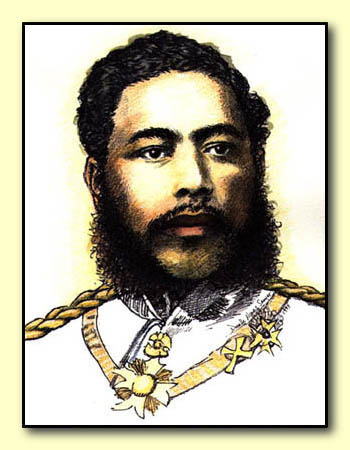
King David Kalākaua
Filled with visionary plans for the protection and development of Hawaiian culture, King Kalākaua actively pursued the revival and perpetuation of chant and hula in the face of fervent opposition by missionary groups. He also encouraged new art forms, the best example of which is his promotion of a hybrid version of two instruments introduced by the Portuguese in 1879, which came to be known as the ʻukulele. King Kalākaua's love of the ʻukulele was perhaps the most important factor in establishing the instrument in Hawaiian music and culture, and its subsequent popularization around the world.
King David Kalākaua (November 16, 1836 – January 20, 1891) was the last reigning king of Hawaiʻi. Known as the "Merrie Monarch" for his love of music, dance, and celebration, Kalākaua was a passionate advocate for Hawaiian culture at a time when it was under considerable pressure from foreign influence.
When Madeiran immigrants arrived in Hawaiʻi in 1879 aboard the Ravenscrag, they brought with them a small four-stringed instrument called the machete de braga. The King was captivated by the sound and immediately embraced the instrument, which soon became known as the ʻukulele — a name commonly translated as "jumping flea," a reference to the rapid finger movements of its players.
Kalākaua incorporated the ʻukulele into royal performances and gatherings at ʻIolani Palace, effectively granting the instrument royal patronage. This endorsement was enormously significant: the King's embrace of the ʻukulele established it as authentically Hawaiian rather than a foreign novelty, and gave it the cultural legitimacy it needed to take root in Hawaiian life.
The King himself was a skilled musician who played guitar and other instruments and composed music, most famously the beloved "Hawaiʻi Ponoʻī," which became the Hawaiian national anthem. His court musician, Heinrich Berger, helped arrange and notate many Hawaiian songs, and the ʻukulele became a fixture of court entertainment.
Kalākaua also actively promoted Hawaiian culture more broadly — he revived the hula, which had been suppressed by missionaries, and founded the Hale Naua society to preserve traditional Hawaiian arts and sciences. His patronage of the ʻukulele was of a piece with this larger project of cultural preservation and promotion.
By the time of his death in 1891, the ʻukulele had become firmly embedded in Hawaiian musical culture. From there it spread to the mainland United States during the Panama–Pacific International Exposition of 1915 in San Francisco, and eventually to the world. Every ʻukulele played today carries the legacy of a king who saw something special in a small Portuguese guitar and made it Hawaiian.