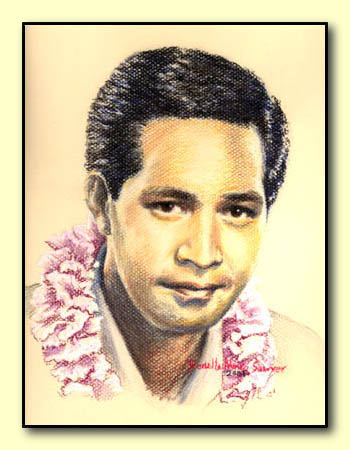
Eddie Kamae
There is perhaps no person who deserves more credit for the popularity of the ʻukulele in modern Hawaiian music than Eddie Kamae. A premiere ʻukulele virtuoso since the early 1940s, Kamae played classical, jazz, and other popular music early in his career. He later devoted himself to Hawaiian music, and led the revolutionary band Sons of Hawaiʻi beginning in 1960. Many of the great Hawaiian ʻukulele players of the last forty years credit the Sons of Hawaiʻi, and particularly Eddie Kamae, with igniting their love for the ʻukulele. Kamae has also been the mentor of many great players, most notably ʻukulele virtuoso and 2006 ʻUkulele Hall of Fame Inductee Herb Ohta.
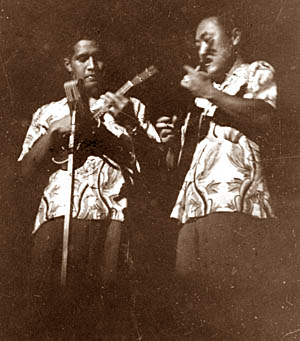
Hawaiian native Edward Leilani Kamae was born in Honolulu in 1927 and has made a life from his talents as an ʻukulele virtuoso, singer and composer, co-founder of the legendary band Sons of Hawaii, filmmaker, researcher, and key figure in the Hawaiian Cultural Renaissance.
Kamae grew up in the Kalihi Valley area of Honolulu and first discovered the ʻukulele in his early teens. He was largely self-taught, but his natural virtuosity drew the attention of established musicians. By his early 20s he was already recognized as an exceptionally gifted player whose technique surpassed that of most older musicians.
In 1960, Kamae co-founded Sons of Hawaiʻi with slack-key guitarist Gabby Pahinui, helping to spark a revival of traditional Hawaiian music at a time when it was being eclipsed by mainland popular styles. The group's recordings and performances brought an entire generation back to Hawaiian music and established the ʻukulele as an instrument of profound expressive power in that tradition.
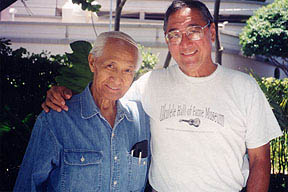
Kamae was also the mentor of Herb Ohta, who went on to become one of the most celebrated ʻukulele virtuosos in the world and himself a Hall of Fame inductee. The lineage of teaching and inspiration that flows through Kamae touches virtually every serious Hawaiian ʻukulele player of the modern era.
Later in his career, Kamae became a filmmaker, producing a series of award-winning documentaries about Hawaiian music and culture. His films helped to document and preserve the knowledge of traditional Hawaiian musicians and cultural practitioners.