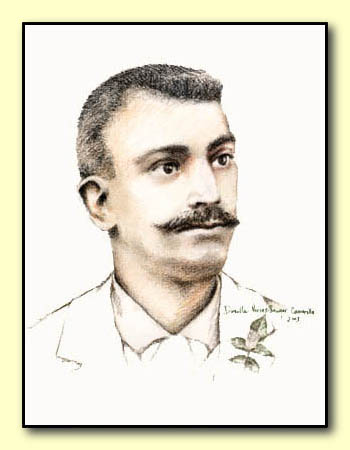
Augusto Dias
Augusto Dias, Manuel Nunes, and Jose do Espirito Santo were the very first ʻukulele luthiers. Dias is the first luthier in Hawaiʻi for whom there is any documentation: the 1884 Honolulu directory lists Augusto Dias, guitar and furniture maker, as living and working in Chinatown. In addition to his skills in building beautiful instruments, Dias was a talented ʻukulele player. He was among those who entertained King David Kalakaua in the royal bungalow on the grounds of Iolani Palace. Dias, Nunes, and Santo all played a role in the transformation of the Madeiran machete to the Hawaiian ʻukulele. These three luthiers produced the instruments that allowed early musicians to establish the popularity of the ʻukulele in Hawaiʻi in the late 1800s and early 1900s.
ʻUkulele pioneer Augusto Dias was born on October 3, 1842, in Funchal, Madeira, the son of barrelmaker João Dias and his wife Maria Julia. His early years were marked by the series of natural disasters that plagued Madeira in the mid-19th century — famine, a cholera epidemic, a fungus that devastated the island's vineyards — but he survived to become a marceneiro, or cabinetmaker. He is supposed to have been a talented singer and player on both the viola (guitar) and machete, the ʻukulele's immediate ancestor, and to have played in string orchestras in Funchal. He was one of the first Madeirans to respond to the call for contract workers in Hawaii, and he and his family arrived in Honolulu on August 23, 1879 aboard the Ravenscrag — the same ship that also carried fellow ʻukulele pioneers Manuel Nunes and Jose do Espirito Santo.
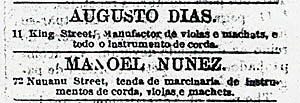
Augusto, who according to family tradition was shocked to learn that he had been hired as a plantation hand, worked on the islands of Hawaii and Kauai before returning to Honolulu by 1883. He is the first luthier in Hawaii for whom there is any documentation: the 1884 Honolulu directory lists Augusto Dias, guitar and furniture maker, as living and working in Chinatown at 11 King Street. For the next 16 years, he worked from a variety of small shops in downtown Honolulu, using his craftsmanship and playing and singing skills to help Nunes and Santo popularize the new instrument that quickly became known as the ʻukulele.
Together with fellow immigrants João Fernandes and João Luiz Correa, Augusto was among those who entertained King David Kalākaua in the royal bungalow on the grounds of ʻIolani Palace. According to Christina, the oldest of his nine children, the king was a regular visitor to the Dias shop — she serving as translator for the king, who could not speak Portuguese, and Augusto, who could not speak English.
Tragedy struck when Augusto's shop was destroyed in Honolulu's Chinatown fire of January 22, 1900. For the next three years, he went back to the cabinetmaker's trade, working for the Porter Furniture Co. By 1904, he was once again working as a guitar maker out of his Luso Street home, and in 1907 he opened up a new shop on Union Street. He continued to work on Union Street until 1910, when a serious illness — apparently pulmonary tuberculosis — forced him into retirement.
He died on Luso Street on February 5, 1915, just a few days before the opening of the Panama-Pacific International Exposition, where the ʻukulele and Hawaiian music began a national fad. He is buried in Makiki Cemetery in Honolulu.