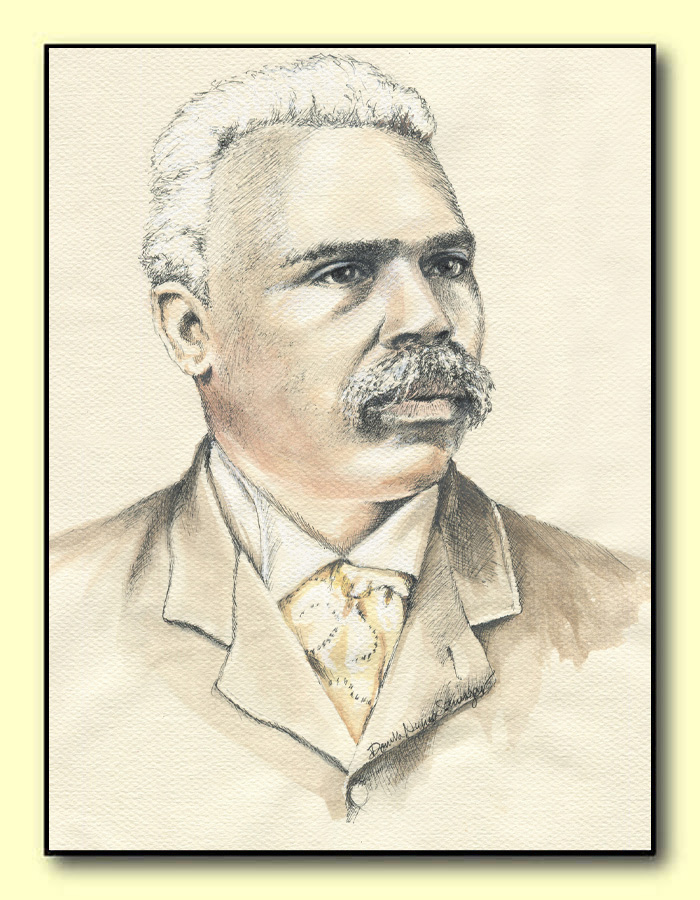
Jose do Espirito Santo
Jose do Espirito Santo, Augusto Dias, and Manuel Nunes were the very first ʻukulele luthiers. Santo was making instruments in Honolulu by the mid-1880s. He operated out of a variety of downtown locations, and was the first of the three original makers to specifically advertise the sale of "ukulele" — in 1895. Nunes, Santo, and Dias all played a role in the transformation of the Madeiran machete to the Hawaiian ʻukulele. Although Dias and Santo did not stay in the business as long as Nunes, all three were responsible for producing the instruments that allowed early musicians to establish the popularity of the ʻukulele in Hawaiʻi in the late 1800s and early 1900s.
ʻUkulele pioneer Jose do Espirito Santo was born on August 27, 1850 in Funchal, Madeira, the son of Antonio do Espirito Santo and his wife Josefa Joaquina. Like Augusto Dias and Manuel Nunes, Espirito Santo worked as a marceneiro, or cabinetmaker, in Funchal, before boarding the Ravenscrag with his family to come to Hawaii as a contract worker. He arrived in Honolulu on August 23, 1879, on the same ship as Manuel Nunes and Augusto Dias.
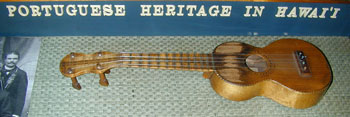
Where Santo spent his first years has not been determined, but by 1884–85 he appears to have returned to Honolulu, where he worked as a cabinetmaker at C.E. Williams' Pioneer Furniture House on Fort Street. By 1886, he had his own downtown guitar maker's shop, making him one of the first three original ʻukulele makers. He operated out of a variety of downtown locations, and was the first of the three to specifically advertise the sale of ʻukulele, in 1898.
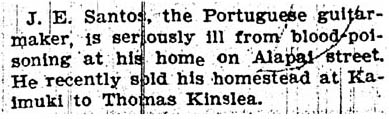
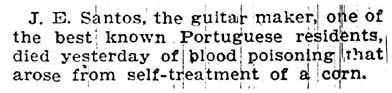
Tragically, Santo, a diabetic, died in Honolulu on June 10, 1905 "of blood poisoning that arose from self-treatment of a corn," as the Sunday Advertiser reported. He is buried in the King Street Cemetery in Honolulu — the same cemetery where Manuel Nunes and his wife Isabel were also laid to rest.
Although Dias and Santo did not stay in the ʻukulele business as long as Nunes, all three were responsible for producing the instruments that allowed early musicians to establish the popularity of the ʻukulele in Hawaiʻi in the late 1800s and early 1900s. Their collective legacy is the instrument heard and played by millions of people around the world today.